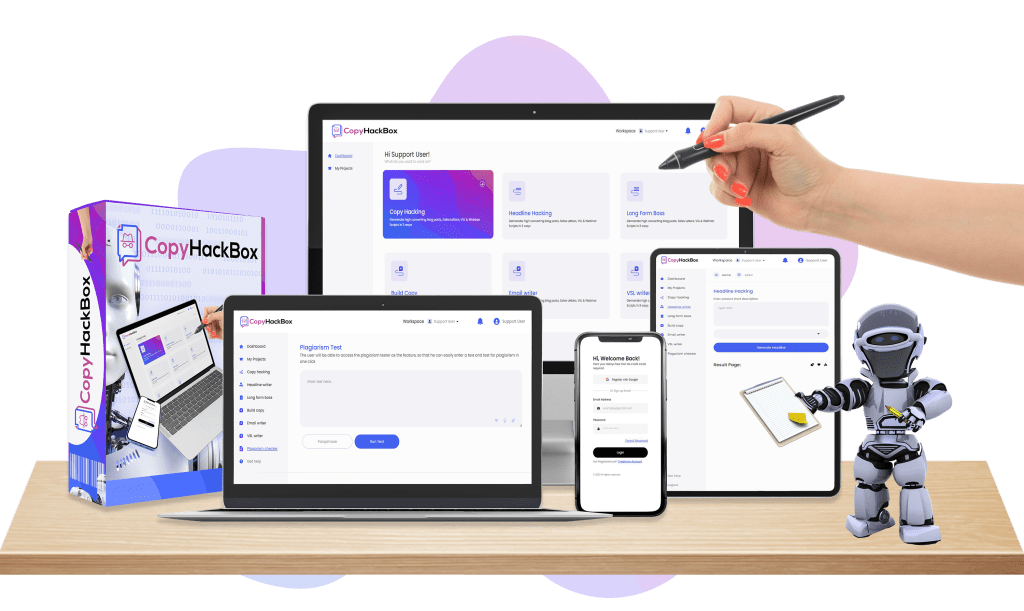
Welcome to my CopyHackBox review, a product from Misan Morrison, one of the most completed Artificial Intelligent content creator on the internet with the ability to generate any kind of content and sales letter that sells.
The Ultimate Guide to Writing Killer AI-Driven Sales Copy
As technology continues to advance, businesses are finding new ways to stay ahead of the competition. One of the latest trends in marketing is the use of artificial intelligence (AI) to create compelling sales copy that converts leads into customers. AI technology can help businesses write copy that is personalized, persuasive and relevant to their target audience. In this ultimate guide, we’ll explore how businesses can harness the power of AI technology to write killer sales copy that drives conversions and boosts revenue. With AI technology on their side, businesses can revolutionize their sales strategies, achieve higher conversion rates, and gain a competitive edge. So let’s dive in and explore how your business can benefit from AI-driven sales copy.
Understand the role of AI in sales copywriting
If you’re reading this, chances are you’re well aware of how artificial intelligence (AI) is transforming nearly every industry. And sales copywriting is no exception.
Gone are the days of relying solely on intuition and experience to write compelling sales copy. With AI-powered tools, marketers can now analyze data, target specific audience segments, and even generate copy that resonates with potential customers on a deeper level.
The benefits of incorporating AI into your sales copywriting strategy are plentiful. Not only does AI save valuable time and resources, but it also allows for a more personalized approach to copywriting.
Take, for example, the AI-powered copywriting tool, Persado. This platform uses algorithms to analyze data on language patterns, sentiment, and emotional triggers, allowing brands to generate copy that is specifically tailored to their target audience.
One successful campaign that utilized Persado’s technology was a campaign run by Expedia. By using Persado’s AI-generated copy, they saw a staggering 30% increase in click-through rates (CTR).
Another example of successful AI-driven sales copywriting is the fashion brand H&M. In 2019, they used an AI-powered tool called Ivy to generate product descriptions for their e-commerce site. As a result, they saw a 22% increase in conversions.
But it’s not just the big brands that are benefiting from AI-powered copywriting. Even small businesses can use AI tools like Grammarly or Frase to optimize their copywriting process and create more effective, customer-centric marketing messages.
When it comes to harnessing the power of AI in sales copywriting, it’s important to remember that technology alone isn’t enough. As with any marketing strategy, a personalized and human touch is essential in building trust with consumers.
So, when optimizing your AI-generated sales copy, be sure to keep the following tips in mind:
1. Understand your target audience – AI tools can only do so much. To truly connect with your audience, you need to research and understand their pain points, motivations, and aspirations.
2. Use a conversational tone – Remember that you’re writing for people, not robots. Use natural language that resonates with your audience.
3. Highlight benefits, not features – Rather than focusing on the features of your product or service, focus on how it can benefit your customers.
4. Test and analyze – Even the best AI tools require testing and analysis to optimize their effectiveness. Use A/B testing and other metrics to continually improve your sales copywriting strategy.
Incorporating AI into your sales copywriting strategy has the potential to revolutionize your marketing efforts. By understanding the role of AI, utilizing the right tools, and maintaining a human touch, you can create killer copy that drives conversions and builds a deeper relationship with your audience.
Identify the target audience and their pain points
Are you tired of writing sales copy that doesn’t convert? Do you want to take your copywriting game to the next level and create killer sales copy that speaks directly to the pain points of your target audience? If you answered yes to these questions, then you’re in the right place.
Thanks to AI-driven copywriting methods, it’s now possible to craft persuasive sales copy that’s tailored to the unique needs of your target audience. By leveraging the power of data and machine learning algorithms, you can create sales copy that resonates with your prospects, compelling them to take action.
The first step in writing AI-driven sales copy is to identify the pain points of your target audience. What are their biggest challenges and obstacles? What keeps them up at night? And most importantly, how can your product or service help them overcome these challenges?
Once you have a clear understanding of your target audience’s pain points, you can begin crafting a compelling story that speaks directly to their needs. Your AI-driven copy should be engaging, informative and persuasive, offering a clear solution to their problems and addressing any objections or concerns they may have.
Of course, creating killer sales copy isn’t a one-and-done process. It requires ongoing testing and optimization to ensure maximum effectiveness. By analyzing data and metrics, you can identify which copy is resonating with your audience and which isn’t, allowing you to make informed decisions about how to tweak your messaging for greater impact.
Ultimately, the key to writing killer AI-driven sales copy is to understand your target audience inside and out. By leveraging the power of data and insights, you can create sales copy that speaks directly to their needs, compelling them to take action and ultimately driving greater revenue and growth for your business. So why wait? Start crafting your killer AI-driven sales copy today and see the results for yourself!
Learn the art of storytelling in copywriting
Storytelling has been a part of human culture for thousands of years. From the earliest cave paintings to modern-day blockbuster films, storytelling has the power to captivate, engage and inspire. So, it’s no surprise that this art form has found a natural home in the world of sales copywriting.
When it comes to crafting killer AI-driven sales copy, storytelling is a vital tool in your arsenal. Not only does it help you stand out from the competition, but it also allows you to create an emotional connection with your prospects and customers. In short, it makes your messaging more human and relatable.
But how do you use storytelling effectively in sales copywriting? Here are some tips to help you get started:
1. Understand the power of storytelling in sales copy
The human brain is hardwired to respond to stories. When we hear a compelling story, our brains start releasing hormones like oxytocin and dopamine, both of which are associated with trust and positive emotions. This means that if you can craft a story that resonates with your audience, they’re more likely to trust you, engage with your messaging and take action.
2. Use storytelling to address pain points
One effective way to use storytelling in sales copy is to use it to address your audience’s pain points. For example, you could start by telling a story about someone who was struggling with a particular problem, and then show how your product or service helped them overcome it. This not only helps you create an emotional connection with your audience, but it also shows them that you understand their problems and have a solution that can help.
3. Keep it relevant and personal
While storytelling is a powerful tool, it’s important to remember that your audience doesn’t want to hear irrelevant or generic stories. This is where data comes into play. By analyzing customer data and insights, you can craft stories that resonate with your target audience on a personal level. The key is to find a balance between personalization and relevance. You want to create a story that feels personal without coming across as spammy or intrusive.
4. Test, measure and refine your messaging
Finally, it’s important to test and measure your messaging to see what’s resonating with your audience. Use analytics tools to track metrics like open rates, click-through rates, and conversion rates. This will help you understand what’s working and what’s not, so you can refine your messaging accordingly.
In conclusion, storytelling is a powerful tool when it comes to crafting killer AI-driven sales copy. By understanding the power of storytelling, using it to address pain points, and balancing personalization with relevance, you’ll be able to create messaging that engages your audience and drives conversions. Don’t forget to test, measure, and refine your messaging over time to ensure you’re always improving and staying ahead of the competition.
Use data and analytics to improve sales copy
In today’s highly competitive digital landscape, crafting compelling sales copy is crucial to the success of any business. As technology evolves, businesses are turning to artificial intelligence (AI) to improve their sales copy and increase conversions. In this guide, we’ll explore how you can use data and analytics to create killer AI-driven sales copy that resonates with your audience.
To begin with, utilizing customer behavior data can help businesses create customized messaging that speaks to their audience’s pain points and motivators. By analyzing customer trends and behaviors, businesses can tailor their messaging, resulting in higher engagement and conversions. For instance, if a business discovers that its audience responds positively to certain keywords or phrases, it can use that information to create more targeted messaging.
Another powerful tool in AI-driven sales copywriting is AI-powered language generators. These tools leverage natural language processing (NLP) technology to generate high-quality copy that resonates with customers. With the help of AI, businesses can produce compelling copy that speaks to their audience’s pain points, and ultimately motivate them to take action. Additionally, these tools can help businesses save time and effort by automating the copywriting process.
As more people use voice search devices like Amazon Alexa and Google Home to find and purchase products, businesses must ensure their sales copy is optimized for these platforms. To achieve this, businesses should use conversational language and natural-sounding phrases that mimic how people speak. By optimizing sales copy for voice search, businesses can increase their chances of appearing in search results and ultimately, drive more conversions.
Finally, A/B testing is a great way to test and refine sales copy with AI. A/B testing allows businesses to compare two different versions of their sales copy and determine which one performs best. By measuring the data and analytics from these tests, businesses can identify which copywriting strategies work best for their target audience.
In conclusion, by utilizing data and analytics, leveraging AI-powered language generators, optimizing copy for voice search, and testing and refining copy with A/B testing, businesses can create killer AI-driven sales copy that speaks to their audience’s pain points and motivators. As technology continues to evolve, it’s important to stay up-to-date on the latest trends and tools to remain competitive in a crowded market.
 Daily Job Killer